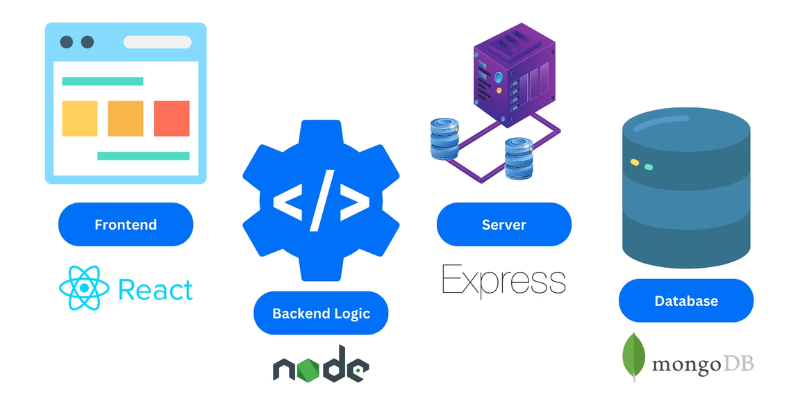
As companies shift toward scalable, cloud-based, and interactive web applications, the need for full-stack web developers has surged. The MERN stack has become one of the most favored options for contemporary web development among various technology stacks. MERN is an acronym for four robust JavaScript-based technologies that integrate smoothly: MongoDB, Express.js, React, and Node.js.
MERN is particularly appealing because it allows developers to use JavaScript for the whole application, including frontend, backend, and database interactions. This uniformity enhances productivity, makes debugging easier, and reduces the duration of development cycles. By mastering the MERN stack, you can qualify for positions like full-stack developer, frontend engineer, backend developer, and software engineer. This manual details a systematic approach to learning and mastering MERN for successful real-world web development. FITA Academy empowers learners with in-demand MERN Stack skills, aligning MongoDB, Express.js, React, and Node.js with real-world full-stack application development and enterprise project requirements.
Understanding the MERN Stack Architecture
Before you can master MERN, you need to grasp how its components interact with each other. MongoDB acts as the NoSQL database, where data is stored in flexible, JSON-like documents. Express.js serves as the backend framework, managing routing, middleware, and API logic. The runtime environment that runs JavaScript server-side is provided by Node.js.
React enables the frontend by creating rapid, interactive user interfaces with reusable components. In a typical MERN application, requests are sent from React to Express APIs, processed by Node, and data is stored or retrieved from MongoDB. This division of concerns results in a neat and scalable architecture. Developers can debug problems, create improved APIs, and develop maintainable applications that function effectively in real-world scenarios by comprehending this flow.
Prerequisites for Learning the MERN Stack
A solid grasp of fundamental web technologies is essential before you can start working with MERN. JavaScript is the key prerequisite, particularly concepts such as variables, functions, arrays, objects, promises, and asynchronous programming. It is essential to be familiar with ES6 features like arrow functions, destructuring, spread operators, and modules.
It is also necessary that you feel at ease working with HTML and CSS to design and format web pages. A fundamental comprehension of HTTP methods, REST APIs, and the workings of the web aids in the quicker understanding of backend concepts. Although novices can learn MERN from the ground up, possessing these basics greatly speeds up the learning process and diminishes confusion when dealing with intricate applications. The MERN Stack Course in Chennai offers hands-on, industry-oriented training in MongoDB, Express.js, React, and Node.js, preparing learners for real-world full-stack development and enterprise application roles.
Setting Up the MERN Development Environment
For seamless MERN development, a suitable development environment is essential. Begin with the installation of Node.js and npm, which enable you to execute JavaScript on the server side and handle dependencies. MongoDB can either be installed on a local machine or accessed via cloud services such as MongoDB Atlas. Extensions for linting, debugging, and formatting enhance productivity in code editors like Visual Studio Code. Postman is a useful tool for API testing, whereas Git facilitates version control and teamwork. By arranging your environment early, you guarantee that your attention can be directed toward coding instead of configuration problems. A tidy arrangement reflects professional development workflows and readies you for actual projects.
Mastering MongoDB for Database Management
MongoDB, a NoSQL database based on documents, provides flexibility and scalability. MongoDB utilizes collections and documents rather than tables and rows, making it well-suited for dynamic applications. Learning the CRUD operations The first step is Create, Read, Update, and Delete. It is also important to grasp schema design, indexing, and the relationships that can be established through references or embedded documents. Libraries such as Mongoose make it easier to interact with databases by offering query helpers and schema validation. Performance enhancement and bug reduction can be achieved through efficient data modeling. Developers who master MongoDB can manage large datasets, ensure secure handling of user data, and create applications that scale smoothly with increasing user demands. These are some benefits of using the MERN stack in web development.
Building RESTful APIs with Express.js and Node.js
Express.js serves as the foundation for backend development within MERN. By managing routing, middleware, and request-response cycles, it makes the construction of RESTful APIs easier. Learning to structure routes, controllers, and services makes your backend code modular and easier to maintain. Middleware is crucial for functions such as authentication, logging, and error management. With its capability for non-blocking and asynchronous execution, Node.js contributes to the speed and efficiency of applications. Grasping the management of environment variables, error handling, and input validation guarantees backend reliability. Developers can create secure and scalable APIs that drive modern web applications with a solid understanding of Express and Node.
Developing Dynamic User Interfaces with React
At the frontend of the MERN stack is React, which is its heart. Important concepts comprise JSX, props, state, and hooks like useState and useEffect. Grasping the component lifecycle and conditional rendering aids in building responsive applications. The virtual DOM of React enhances performance by updating only the parts of the UI that are necessary. It is crucial to learn how to manage forms, handle events, and structure components. With the growth of applications, it is essential to comprehend state management patterns. When developers master React, they can build speedy, intuitive interfaces that improve user experience.
Connecting Frontend and Backend in MERN Applications
The real strength of MERN comes to light when the frontend and backend collaborate without friction. React utilizes HTTP requests made with tools such as fetch or Axios to interact with Express APIs. Knowing how to deal with responses, control loading states, and show errors enhances the reliability of applications. It is also important to learn how to handle global state when data must be shared between components. Smooth data flow and responsive UI behavior are ensured by proper API integration. This link converts separate elements into a full-fledged, operational web application that can manage practical use cases.
Implementing Authentication, Authorization, and Security
In MERN development, security is crucial. Authentication confirms who the user is, whereas authorization manages access to resources. User data is safeguarded by implementing secure login systems that utilize JSON Web Tokens (JWT) or sessions. Common vulnerabilities can be prevented through password hashing, input validation, and secure HTTP headers. Role-based access control guarantees that only users with authorization can execute sensitive actions. Learning security best practices helps developers build trustworthy applications that meet industry standards. A secure MERN application safeguards users and boosts professional credibility.
Optimizing Performance and Debugging MERN Applications
Performance optimization guarantees that your MERN applications operate efficiently when under load. Efficient queries, proper indexing, and caching strategies are all part of backend optimization. The focus of frontend optimization lies in minimizing bundle sizes, lazy loading components, and reducing unnecessary re-renders. Debugging tools available in browsers and Node.js assist in quickly pinpointing problems. Through logging and monitoring, one can gain insight into how applications behave. By grasping optimization methods, developers get ready to manage actual traffic and scale applications with assurance. Development that emphasizes performance distinguishes projects in their initial stages from applications that are ready for production.
Building Real-World Projects and Deployment Strategies
To master MERN, practical experience is crucial. Reinforcing learning occurs through the construction of actual projects like social applications, dashboards, or e-commerce platforms. Projects assist you in applying concepts such as authentication, database design, and API integration. The last step is deployment, which entails hosting both the frontend and backend on cloud platforms. Grasping environment configuration, build processes, and the fundamentals of CI/CD equips you for professional development positions. A robust collection of deployed MERN projects greatly enhances employment prospects and showcases practical competence.
Your Roadmap to MERN Stack Mastery
To master the MERN stack, one needs to be patient, practice regularly, and adopt an organized learning strategy. You cultivate your confidence and technical skills by grasping the architecture, reinforcing prerequisites, and constructing actual projects. The JavaScript-driven ecosystem of MERN makes it perfect for contemporary web development, providing scalability, flexibility, and performance. No matter if your goal is to become a full-stack developer or to improve your web development skills, MERN offers a robust career pathway. Maintain your consistency, continue to build, and enhance yourself continuously mastery of MERN is a worthwhile investment for your future as a web developer.